European Bee-Eater Facts
Mukesh Kumar
| 24-08-2026
 · Animal Team
Imagine walking through open countryside and suddenly noticing a flash of green, blue, yellow, and chestnut perched on a branch.
You may have just spotted a European bee-eater (Merops apiaster), a striking bird recognized for its vivid plumage, agile flight, and specialized insect-hunting skills.
Its beauty is only part of the story. The European bee-eater has fascinating feeding habits, seasonal movements, social behavior, and nesting techniques that make it especially interesting to observe.
It Uses Elevated Perches for Hunting
European bee-eaters often use exposed branches, fences, wires, or other elevated positions as hunting perches. From these locations, they can watch the surrounding air for flying insects.
When suitable prey approaches, the bird launches into flight, catches the insect in mid-air, and often returns to a perch. This efficient technique allows it to combine patience with sudden bursts of speed.
Its Plumage Is Exceptionally Colorful
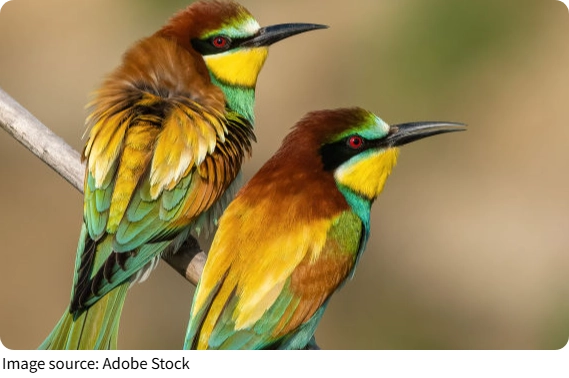
The European bee-eater has a distinctive combination of green, blue, yellow, chestnut, and turquoise feathers. A dark eye stripe and slender shape add to its recognizable appearance.
Adults generally display particularly vivid coloration, giving the species an unmistakable appearance. Its striking plumage makes it a memorable sight for wildlife observers.
Bees Are Not Its Only Food
Despite its name, the European bee-eater does not depend exclusively on bees. Its diet includes a variety of flying insects, such as wasps, dragonflies, beetles, butterflies, moths, and other insects.
When a bee or wasp is caught, the bird may repeatedly strike it against a perch before swallowing it. This behavior helps it handle prey with a sting.
It Makes Remarkable Seasonal Journeys
European bee-eaters are migratory birds. Many populations breed in Europe before traveling to Africa during the non-breeding season.
These journeys can cover thousands of kilometers, connecting different habitats throughout the year. Migration is an important part of the species' natural life cycle and allows it to follow favorable seasonal conditions.
It Is a Social Bird
European bee-eaters often live and breed in groups, particularly during the breeding season. Colonies may contain numerous pairs nesting within the same general area.
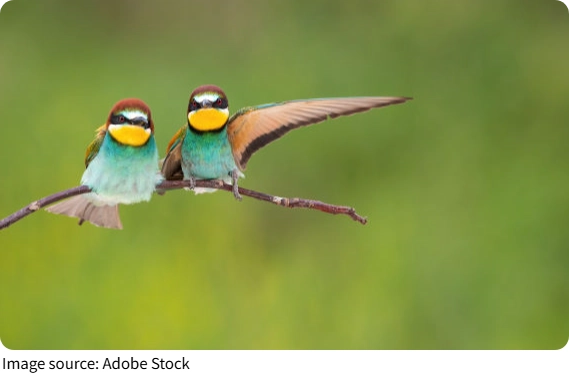
Several birds may gather on exposed perches or fly together while feeding. Their calls and movements also play an important role in communication within the group.
It Nests in the Ground
Although the European bee-eater frequently rests on elevated perches, it does not build its nest in a tree.
Instead, it excavates a tunnel in suitable soil, often in sandy banks or other areas with appropriate ground conditions. The tunnel leads to a nesting chamber where the eggs are laid.
This combination of tree-perching and ground nesting is one of the species' most distinctive characteristics.
Its Calls Are Distinctive
The European bee-eater produces recognizable calls that can be heard while birds are flying, feeding, or gathered together.
When several birds are nearby, their repeated calls can create a lively natural soundscape. These vocalizations form an important part of their social communication.
It Is Highly Adapted to Aerial Hunting
The European bee-eater is specially adapted to catching insects in flight. Its streamlined body and pointed wings allow it to make quick, controlled movements while pursuing prey through the air.
Its hunting strategy combines careful observation from a perch with rapid bursts of flight. This specialization makes the species an impressive aerial insect hunter.
A Colorful Bird Worth Discovering
The European bee-eater combines brilliant plumage with highly specialized behavior. Its perch-based hunting, varied insect diet, seasonal migration, social lifestyle, ground-nesting habits, and agile flight all contribute to its distinctive way of life.
For anyone who enjoys wildlife, encountering a European bee-eater can be a memorable experience. A colorful bird resting quietly on a branch can reveal a fascinating story of adaptation, movement, communication, and life in the natural world.